Context
Agriculture remains the backbone of food security — yet, despite rapid technological advancements, global crop losses exceed USD 400 billion annually due to unpredictable weather, pests, and inefficient resource use.
Traditional farming methods rely heavily on human intuition and manual data collection, which limits scalability and precision.
With the climate crisis intensifying and arable land shrinking, Artificial Intelligence (AI) has emerged as a transformative force in achieving sustainable, data-driven agriculture.
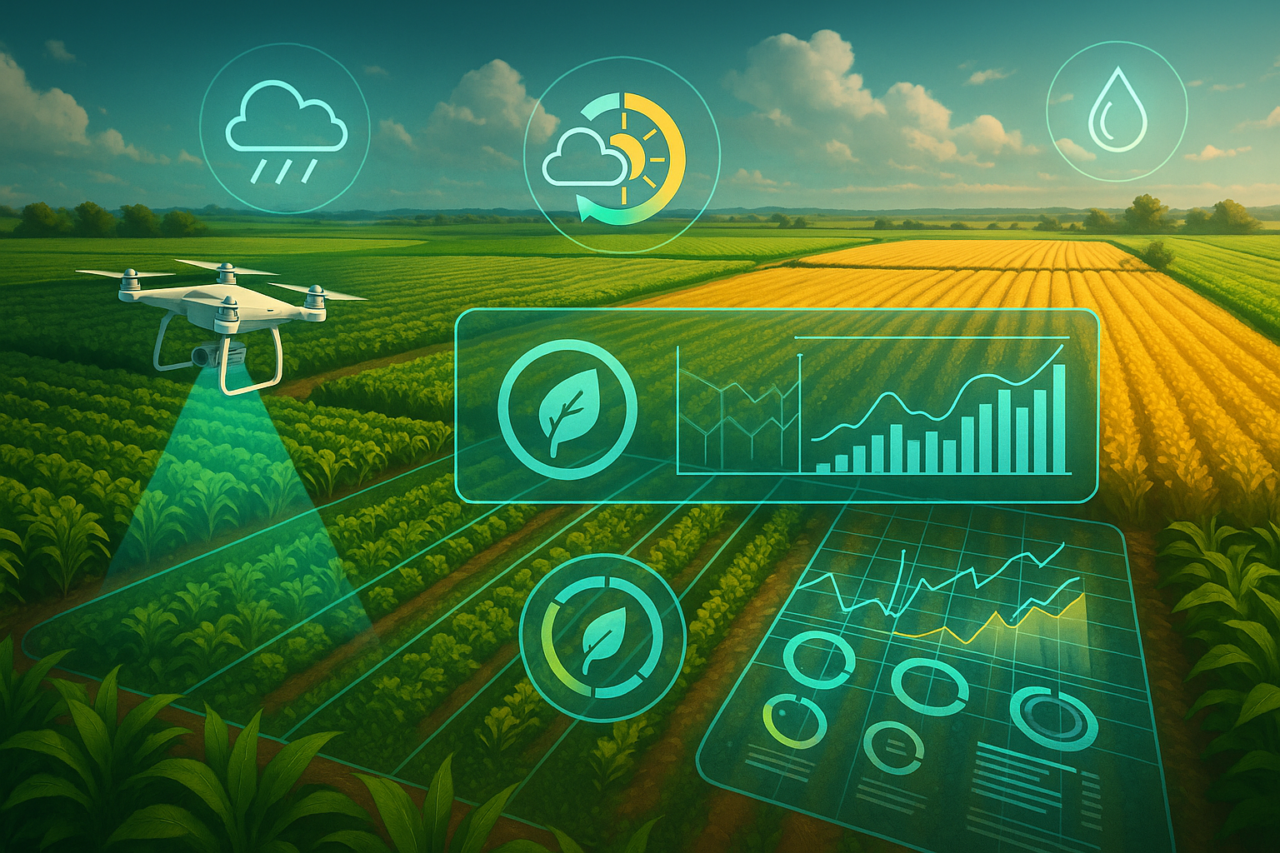
A leading example comes from IBM’s Watson Decision Platform for Agriculture, which integrates AI, IoT, satellite imagery, and weather data to help farmers make real-time decisions on planting, irrigation, and harvesting. This initiative, deployed in collaboration with The Weather Company, has helped thousands of farmers across North America, India, and Africa increase yields by up to 25% while reducing water and fertilizer usage.
(References: IBM Watson Decision Platform for Agriculture, 2024, FAO Climate-Smart Agriculture Report, 2023)
Problem Statement
The global agricultural sector faces several critical and interlinked challenges:
-
Unpredictable Weather Patterns: Climate change has increased the frequency of droughts and floods, making traditional planting cycles unreliable.
-
Resource Waste: Over-irrigation and excessive fertilizer use degrade soil quality and increase environmental pollution.
-
Yield Variability: Lack of real-time monitoring leads to inconsistent yields across regions and crop types.
-
Data Fragmentation: Farmers struggle to interpret data from diverse sources — sensors, satellites, and weather stations.
-
Food Supply Chain Inefficiency: Post-harvest losses due to poor logistics and forecasting impact overall food availability.
To address these issues, IBM developed an AI-powered agricultural decision intelligence platform to combine data from multiple ecosystems and generate actionable insights — effectively giving farmers a digital co-pilot.
Solution: IBM Watson Decision Platform for Agriculture
IBM’s AI platform uses machine learning, satellite imaging, and IoT data to provide farmers with predictive insights on soil health, crop performance, and weather patterns — creating a closed-loop system for precision agriculture.
1. AI-Powered Weather Forecasting and Crop Modeling
-
Leveraging The Weather Company’s global climate datasets, AI models predict microclimate changes and rainfall patterns with 85–90% accuracy.
-
These insights guide farmers on optimal sowing and harvesting dates, reducing weather-related yield losses by up to 20%.
-
Predictive models continuously learn from regional weather data, enabling localized recommendations down to the farm level.
(Reference: IBM Research – Weather AI for Agriculture, 2023)
2. Satellite and Drone-Based Crop Health Monitoring
-
IBM integrates high-resolution satellite and drone imagery with computer vision to detect early signs of pest infestation, drought stress, or disease outbreaks.
-
AI models process multispectral images to identify anomalies invisible to the naked eye, triggering alerts for targeted pesticide or nutrient application.
-
This approach reduces pesticide usage by up to 40% and improves crop health and sustainability.
(Reference: Nature AI Agriculture Review, 2024)
3. Predictive Irrigation and Soil Analytics
-
Soil moisture sensors, combined with AI models, determine the exact amount of water needed at each growth stage.
-
Farmers receive irrigation alerts via mobile dashboards — minimizing overwatering and conserving resources.
-
In India’s pilot project across 12 states, water consumption decreased by 25% while maintaining optimal crop yield.
(Reference: FAO & IBM Pilot Study Report, 2023)
4. Supply Chain Optimization with AI
-
Post-harvest, Watson’s predictive logistics engine forecasts demand trends and identifies the most efficient transport routes.
-
AI models analyze temperature, humidity, and travel time to recommend optimal storage and shipping conditions — preventing spoilage.
-
This system reduced post-harvest food losses by 18% across African pilot programs in Kenya and Nigeria.
(Reference: IBM Food Trust Blockchain & AI Initiative, 2024)
Implementation Roadmap
Phase 1 (2019–2021):
-
Pilot rollout in North America with corn and soybean farmers.
-
Integration of weather forecasting and soil monitoring tools.
Phase 2 (2021–2023):
-
Expansion to Asia and Africa through IBM’s partnership with local governments and NGOs.
-
Incorporation of drone and satellite image analytics.
Phase 3 (2023–2025):
-
Development of AI-powered food supply chain optimization.
-
Integration with IBM Food Trust blockchain for traceability from farm to consumer.
Results & Impact
The platform’s deployment has had significant measurable outcomes:
-
Crop Yield Increase: Average yield improvement of 20–25% across pilot regions.
-
Water Efficiency: Up to 25% reduction in irrigation usage.
-
Pesticide Reduction: Decrease of 40% in chemical use.
-
Waste Reduction: 18% reduction in post-harvest losses due to predictive supply chain management.
-
Operational Cost Savings: Farmers report up to USD 70–100 savings per acre annually through optimized inputs.
-
Sustainability Gains: Reduced carbon footprint from lower fertilizer and energy usage.
(References: IBM Watson Agriculture Case Study, FAO Annual Report 2024, World Bank AgriTech Review 2024)
Challenges & Lessons Learned
-
Connectivity Barriers: Limited internet infrastructure in rural areas restricted data transmission.
-
Data Diversity: Combining soil, weather, and imagery data required robust preprocessing and normalization pipelines.
-
Adoption Resistance: Some farmers were hesitant to trust AI-driven insights over traditional methods.
-
Localization Needs: AI models had to be regionally retrained to adapt to local crops, soil types, and languages.
-
Affordability: High sensor costs initially limited scalability until subscription-based models were introduced.
Future Outlook
IBM aims to scale this platform into a global climate-resilient agriculture network, supporting both smallholder and industrial-scale farmers.
Upcoming innovations include:
-
Generative AI Crop Simulation: Using LLMs to simulate yield outcomes based on weather scenarios.
-
AI-Powered Carbon Sequestration Modeling: Helping farmers earn carbon credits by tracking soil health improvements.
-
Autonomous Farming Equipment: Integration of AI with robotic tractors and drones for end-to-end automation.
-
Global Food Security Dashboards: Using AI to forecast regional food shortages and guide relief planning.
As the world’s population approaches 9 billion by 2050, AI will be essential in ensuring food availability, reducing waste, and promoting environmental stewardship.
(References: IBM Watsonx Sustainability Report 2025, UN Food Security AI Framework 2024)