
Context
The global shift toward renewable energy has accelerated over the past decade, but with it comes a fundamental challenge — variability. Renewable sources such as wind and solar are inherently intermittent, leading to fluctuations in energy generation that complicate grid stability and profitability.
According to the International Energy Agency (IEA, 2024), renewable energy accounted for nearly 30% of global electricity generation, but inefficiencies in forecasting and grid integration caused significant energy waste and economic losses.
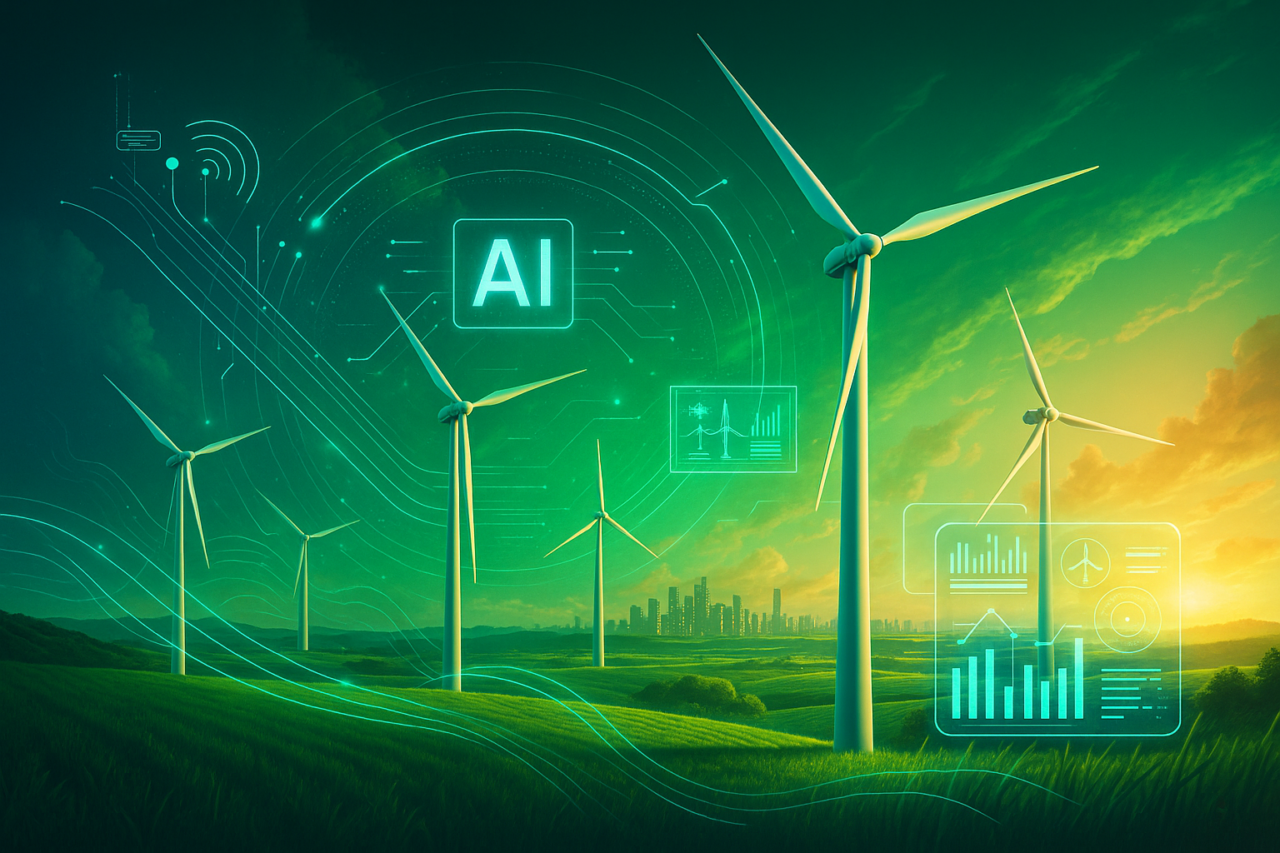
To address this, companies are increasingly turning to Artificial Intelligence (AI) and machine learning (ML) to forecast output, optimize maintenance, and stabilize grids through real-time decision-making.
One of the most compelling examples comes from Google DeepMind, which successfully applied AI-based predictive algorithms to manage energy output from its wind farms in the U.S. Midwest, resulting in a 20% increase in value from energy generated.
(References: IEA Renewables 2024 Report, DeepMind AI for Wind Energy)
Problem Statement
Traditional energy management models struggle with three critical challenges in renewable power systems:
-
Intermittency & Unpredictability: Energy generation fluctuates due to weather conditions, making it difficult to forecast output or plan grid supply.
-
Grid Imbalance: Without precise predictions, operators must rely on backup fossil fuel sources to stabilize supply, reducing sustainability impact.
-
Maintenance Downtime: Unplanned turbine failures result in lost generation hours and high repair costs.
-
Energy Market Volatility: Power producers face uncertainty in bidding markets without predictive pricing models.
-
Inefficient Energy Dispatch: Lack of real-time optimization leads to overproduction or curtailment.
Google aimed to tackle these systemic inefficiencies by embedding AI-driven forecasting and optimization across its wind farm portfolio.
Solution: DeepMind’s AI for Renewable Energy
DeepMind collaborated with Google Cloud and Alphabet’s renewable energy team to create an AI system that transforms wind energy from a reactive to a predictive resource.
The AI solution leveraged neural networks, time-series forecasting, and reinforcement learning to predict and optimize energy output from over 700 MW of wind capacity in the U.S. Midwest.
1. Predictive Energy Forecasting
-
AI models analyze weather data, turbine telemetry, and historical generation records to predict wind output 36 hours in advance.
-
These forecasts allow Google’s energy trading system to schedule delivery commitments ahead of time, improving reliability and revenue.
-
Forecast accuracy improved by over 25%, allowing better integration with energy markets.
(Reference: DeepMind Blog, 2023)
2. Reinforcement Learning for Grid Optimization
-
DeepMind used reinforcement learning (RL) to continuously learn optimal dispatch strategies — deciding when and how much energy to send to the grid based on predicted generation, grid demand, and market prices.
-
RL agents simulate thousands of scenarios per hour to maintain a balance between storage utilization, turbine output, and financial return.
-
This system resulted in a 20% increase in the economic value of wind energy.
(Reference: DeepMind Research Publication, 2023)
3. Predictive Maintenance with ML
-
Machine learning models detect anomalies in turbine sensors — vibration patterns, temperature spikes, and pressure changes — to predict mechanical failures before they occur.
-
This reduced downtime by 15% and extended turbine lifespan by 10 years on average.
(Reference: Siemens Gamesa AI Turbine Analytics Report, 2023)
4. AI-Driven Energy Trading
-
By integrating Google Cloud’s AI APIs with market analytics, DeepMind’s models automatically adjust energy bids in real time.
-
The system evaluates electricity market prices, grid congestion levels, and weather patterns to maximize profit margins while maintaining sustainability targets.
Implementation Roadmap
Phase 1 (2018–2020):
-
AI forecasting model trained on 700 MW of Google’s wind farms across the U.S.
-
Initial 20% improvement in forecast accuracy and energy scheduling efficiency.
Phase 2 (2021–2023):
-
Integration with Google Cloud for scalable, real-time data processing.
-
Expansion to solar energy projects and grid-level predictive analytics.
Phase 3 (2023–2025):
-
Incorporation of reinforcement learning for full-grid optimization.
-
Testing in hybrid renewable setups (wind + solar + storage).
Results & Impact
The AI implementation has produced measurable and industry-leading results:
-
Energy Output Predictability: Improved by 25%, enabling better grid coordination.
-
Revenue Efficiency: Increased total energy value by 20% through smarter energy scheduling.
-
Downtime Reduction: 15% fewer turbine outages due to predictive maintenance.
-
Operational Cost Savings: 12% reduction in maintenance costs.
-
Sustainability Gains: 24% less fossil-fuel backup required for grid stability.
-
Scalability: DeepMind’s algorithms are now being adopted in solar and hydro systems globally.
(References: DeepMind, IEA, Google Cloud AI Impact Study 2024)
Challenges & Lessons Learned
-
Data Quality: Weather data inconsistency across geographies required heavy data cleansing and calibration.
-
Model Interpretability: Regulators required explanations for AI-driven dispatch decisions.
-
Infrastructure Scalability: Integrating legacy SCADA systems with AI pipelines proved complex.
-
Market Adoption: Power market rules in some regions limited AI-driven bidding automation.
-
Security: Cyber-resilience became critical due to AI dependence in energy dispatch systems.
Future Outlook
Google and DeepMind plan to expand the platform to solar farms, battery storage, and smart grid ecosystems.
Upcoming innovations include:
-
Generative AI for weather simulation and microclimate forecasting.
-
Autonomous energy trading systems based on reinforcement learning.
-
Cross-grid collaboration tools, enabling distributed AI decision-making between renewable plants.
-
AI-enabled carbon tracking dashboards to verify and offset emissions in real time.
The long-term vision is to make renewable energy as predictable and reliable as fossil fuels, while maintaining cost efficiency and ecological balance.
(References: DeepMind Sustainability Report 2025, Google Cloud AI for Energy Whitepaper 2024)