Context
The logistics and transportation sector has always been the backbone of global commerce. Yet, it’s also one of the most operationally complex industries — influenced by fluctuating fuel prices, unpredictable weather, variable customer demand, and strict delivery time windows.
In this high-volume environment, even small inefficiencies multiply across thousands of vehicles and routes, leading to staggering losses.
For decades, United Parcel Service (UPS) — one of the world’s largest logistics companies — has handled billions of deliveries annually across more than 220 countries. With over 125,000 drivers covering millions of miles every day, optimizing fleet operations is not merely an operational goal but a strategic necessity.
UPS realized that traditional route planning tools and human decision-making could no longer keep pace with modern challenges. Deliveries had become more time-sensitive, urban congestion more severe, and customer expectations higher.
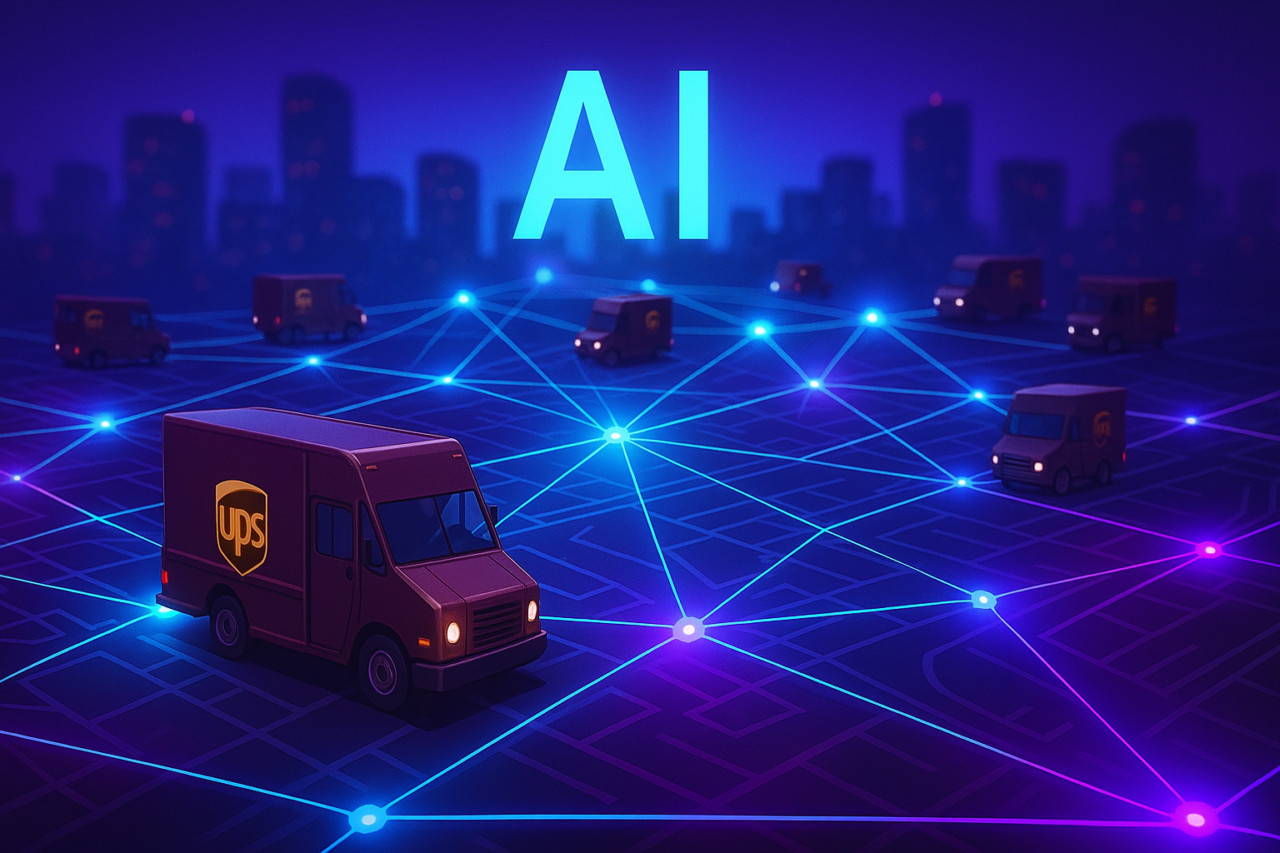
This led to a transformative journey: building and deploying ORION (On-Road Integrated Optimization and Navigation) — an AI-powered routing and navigation system that redefined logistics efficiency.
(Sources: UPS Corporate Sustainability Report, Forbes, McKinsey & Company)
Problem Statement
Before AI integration, UPS faced several persistent challenges:
-
Route Inefficiencies:
Drivers followed static, pre-defined routes that didn’t adapt dynamically to real-world conditions such as traffic jams, accidents, or customer cancellations.
Even a few unnecessary turns per route multiplied into millions of wasted miles annually. -
Fuel Consumption & Emissions:
UPS vehicles consumed over 1.5 billion liters of fuel annually. Each inefficient route increased fuel use and carbon emissions, straining both profitability and sustainability targets. -
Data Silos:
UPS collected immense operational data — GPS signals, driver logs, and delivery timestamps — but lacked a unified system to analyze and act on it in real time. -
Customer Expectations:
The rise of e-commerce and same-day delivery meant that UPS needed precision and speed. Late deliveries were no longer acceptable, especially when competing against Amazon’s logistical prowess. -
Operational Costs:
Every mile, every minute, and every gallon mattered. The lack of real-time optimization resulted in an estimated 10 million unnecessary miles driven per year, directly affecting profitability.
UPS leadership understood that solving these inefficiencies required an intelligent system capable of learning from historical data, adapting to live conditions, and optimizing millions of decisions per day — automatically.
AI-Driven Solution: ORION
In response, UPS invested over USD 1 billion in a decade-long initiative to build ORION (On-Road Integrated Optimization and Navigation) — an advanced AI and operations research platform designed to solve one of the most complex challenges in logistics: dynamic route optimization.
1. Core Functionality
ORION leverages artificial intelligence, machine learning, and prescriptive analytics to determine the most efficient delivery sequence for every driver, every day.
It ingests and processes over 250 million data points daily, including:
-
Package destinations and delivery windows
-
Traffic, weather, and road conditions
-
Driver shift timings and vehicle capacities
-
Historical patterns of delivery success and failure
The system continuously recalculates optimal routes as new data streams in — adjusting for sudden traffic incidents, weather changes, or last-minute customer requests.
2. Machine Learning in Action
Over time, ORION’s algorithms learn from driver behavior, operational feedback, and real-world constraints.
For example:
-
It recognizes frequent stop locations where deliveries take longer.
-
It predicts optimal left-turn avoidance patterns, reducing idle time at intersections.
-
It recommends refueling or maintenance breaks without disrupting the delivery schedule.
UPS designed the system to not just save time — but to reengineer how human drivers interact with technology.
Implementation Process
The rollout of ORION began in 2012, with incremental implementation across U.S. regions before expanding globally. It required close collaboration between data scientists, logistics experts, and drivers.
1. Data Integration
UPS unified data from disparate systems — including telematics sensors, GPS trackers, and enterprise delivery databases — into a single AI framework.
Each delivery vehicle was fitted with IoT sensors that collected:
-
Speed and braking patterns
-
Fuel consumption metrics
-
Idle time duration
-
Route adherence data
This data was then processed through UPS’s internal data lake, where machine learning models analyzed millions of historical deliveries to uncover inefficiency patterns.
2. Human-AI Collaboration
Rather than replacing dispatchers or drivers, ORION augmented their decision-making.
Drivers received real-time route updates via in-cab tablets and mobile devices, which dynamically adjusted as conditions changed.
Training sessions were conducted to familiarize drivers with AI-driven recommendations, ensuring a balance between human intuition and algorithmic precision.
3. Optimization Goals
Each ORION optimization aimed to:
-
Minimize total driving distance.
-
Balance route workloads among drivers.
-
Reduce the number of left turns (a unique UPS strategy that saves time and fuel).
-
Ensure timely completion of all deliveries under compliance and safety guidelines.
Results & Measurable Impact
The impact of ORION has been both financially and environmentally transformative.
1. Massive Fuel and Cost Savings
By optimizing just one mile per driver per day, UPS saves approximately USD 50 million annually.
Since ORION’s full deployment, UPS has:
-
Reduced 100 million miles driven each year.
-
Saved 10 million gallons of fuel annually.
-
Achieved USD 300–400 million in annual savings from reduced operational costs.
2. Environmental Impact
The system has decreased CO₂ emissions by 100,000 metric tons annually — equivalent to removing over 21,000 cars from the road each year.
This milestone contributed directly to UPS’s corporate sustainability goals, aligning with its commitment to reach carbon neutrality by 2050.
3. Enhanced Delivery Performance
-
Improved on-time delivery rates by 25%.
-
Reduced average route duration by 15–20%.
-
Increased driver productivity while lowering stress levels by minimizing time in congested zones.
4. Predictive Maintenance and Safety
AI models now forecast vehicle maintenance needs based on usage data, preventing breakdowns before they occur.
In addition, machine learning models analyze driving patterns to recommend safer driving behaviors — reducing accident rates and insurance costs.
Future Outlook
Following ORION’s success, UPS expanded its AI capabilities into predictive demand forecasting and automated warehouse logistics.
The company’s next evolution — HEART (Harmonized Enterprise Analytics Reality and Telemetry) — integrates AI, IoT, and digital twins to optimize every element of its supply chain, from warehouse automation to final delivery.
UPS is now exploring generative AI applications to simulate routing scenarios, identify new optimization opportunities, and further reduce its carbon footprint.
(Sources: UPS Corporate, Forbes Tech Council, McKinsey)
Key Takeaways for the Industry
-
Data is the new driver: Real-time analytics and route optimization are redefining operational intelligence in logistics.
-
Incremental AI adoption works: UPS didn’t build ORION overnight — success came through phased rollout, testing, and refinement.
-
AI enables sustainability: Cost savings and emissions reduction can coexist when AI models are aligned with environmental goals.
-
Human-AI synergy is critical: Empowering drivers with technology leads to higher adoption, lower resistance, and improved performance.